

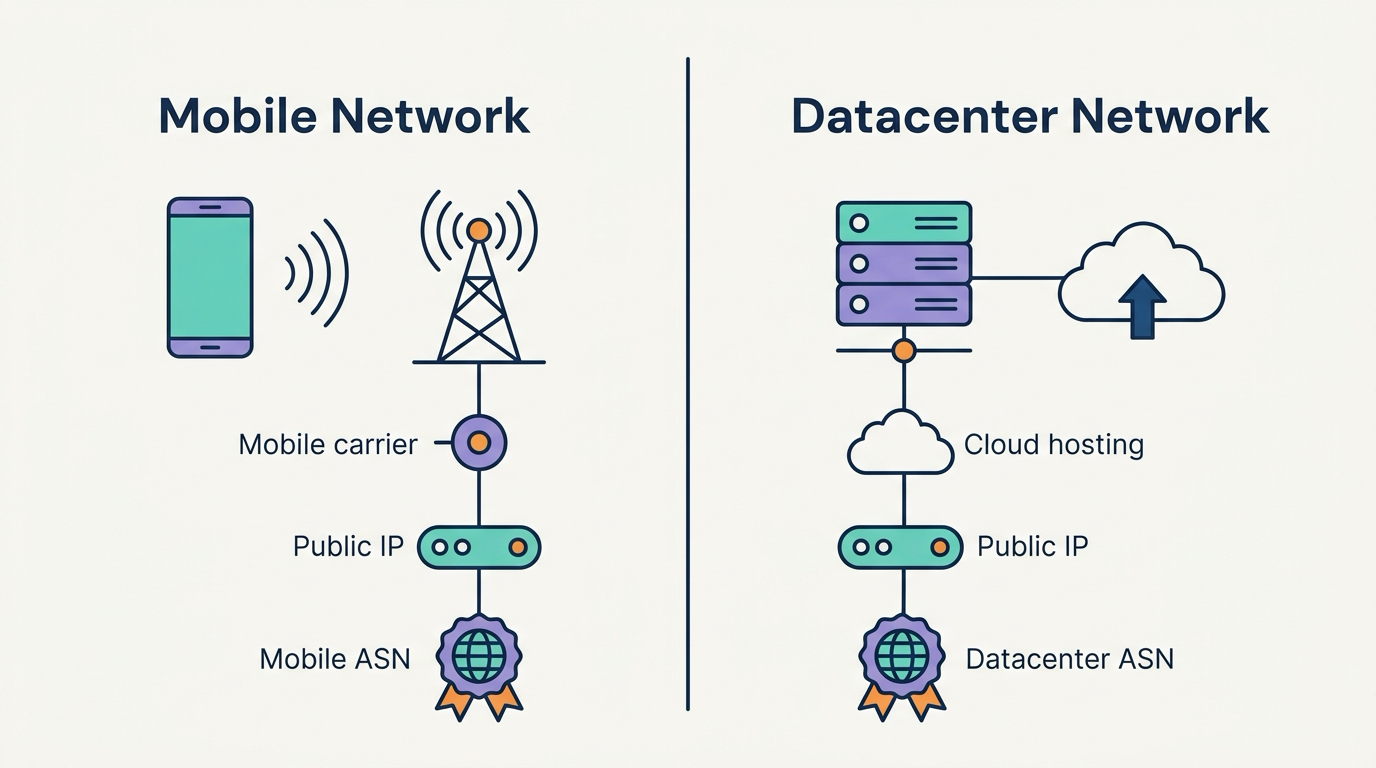
Quick answer: A “mobile IP” usually means the public internet exit is associated with a cellular/mobile network, while a “data-center VPN IP” usually means your traffic first travels through a VPN tunnel to a server hosted in a data center, cloud, or hosting network and then exits through that server's public IP. The most useful differences are the underlying network, ASN/ISP, VPN path, CGNAT/shared-address behavior, and how IP-intelligence databases classify the address. Do not reduce this to “mobile = residential = safe” or “data center = VPN = risky.” Mobile addresses are often shared through CGNAT, VPNs do not always use data-center exits, and different IP databases can classify the same network differently.
This is the third article in the IP/networking cluster.
The previous guides established:
eSIM ≠ VPN
and:
Coverage country ≠ IP country
Now we need to separate another set of terms that are frequently mixed together:
Mobile IP
Residential IP
Data-center IP
VPN IP
Hosting IP
Proxy IP
They can overlap, but they are not synonyms.
Mobile IP vs data-center VPN IP
| Feature | Mobile-network public IP | Data-center VPN exit IP |
|---|---|---|
| Upstream network | Mobile carrier/core network | Data center, cloud, or hosting network running the VPN endpoint |
| Typical ASN | Carrier/mobile/upstream telecom ASN | Cloud, hosting, data-center, or VPN upstream ASN |
| VPN required | No | Usually yes in this comparison |
| CGNAT common | Very common | Depends on architecture |
| Shared public IP possible | Very common | Common, but dedicated exits also exist |
| Always residential | No | No |
| Always classified as mobile | No guarantee | Usually not, but database-dependent |
| Often classified as hosting | Not necessarily | Common for data-center VPN exits |
| IP geolocation equals GPS | No | No |
| Always faster | No | No |
| Always safer | No | No |
| Predicts account risk-control outcome | No | No |
These are general networking characteristics, not guarantees about any account or service.
What does “mobile IP” mean here?
In everyday networking discussions, “mobile IP” often does not mean the IETF Mobile IP protocol.
It usually means:
a public internet exit
used by a phone or mobile device
through a cellular network
A simplified path is:
iPhone / Android
  ↓
5G / LTE
  ↓
Mobile carrier
  ↓
Mobile core
  ↓
CGNAT / Internet gateway
  ↓
Public IP
  ↓
Internet
The website sees the public network exit.
That address may:
- Be shared by many subscribers.
- Change over time.
- Use IPv4 or IPv6.
- Belong to a mobile-carrier ASN.
- Belong to an upstream roaming/core-network ASN.
- Be classified as Cellular by one data provider.
- Be classified differently by another provider.
Using a mobile radio network therefore does not guarantee that every IP-intelligence service labels the final public address as Mobile.
What is a data-center IP?
A data-center IP is generally public address space used or announced by infrastructure such as:
- Cloud providers.
- Hosting providers.
- VPS networks.
- Colocation facilities.
- Data-center networks.
- Enterprise server infrastructure.
A common VPN path is:
Laptop / Phone
  ↓
Internet
  ↓
VPN tunnel
  ↓
VPN server in a data center
  ↓
Data-center public IP
  ↓
Website
The website sees:
the VPN server's public exit IP
rather than the direct public exit of the mobile eSIM.
Is every VPN IP a data-center IP?
No.
Many consumer VPN services do run servers in:
- Clouds.
- Hosting networks.
- Data centers.
Those addresses may therefore be labeled by IP-intelligence systems as:
Hosting provider
Anonymous VPN
Data center
But a VPN endpoint can also exist on:
- A corporate private network.
- A home network.
- A dedicated gateway.
- Other upstream networks.
- Certain residential or mobile exits.
Therefore:
VPN = data center
is not a technical definition.
The accurate statement is:
A particular VPN exit may be hosted in a data center.
Is a mobile IP the same as a residential IP?
No.
“Residential” and “Mobile” can be separate classifications.
Residential often describes address space associated with end-user broadband or non-hosting ISP access.
Mobile generally describes:
cellular/mobile network connectivity
An IP-intelligence product may distinguish the two.
Do not use:
Mobile Residential IP
as a universal technical name for every cellular internet connection.
Only use that classification when an actual data source or product explicitly supports it.
ASN is an important clue to network origin
ASN stands for Autonomous System Number.
ARIN describes an Autonomous System as a network or connected group of networks that follows a distinct routing policy.
An IP lookup may show:
ASN: ASxxxxx
Organization: Example Telecom
ISP: Example Mobile
The ASN helps answer:
Which network organization is associated with routing this address space?
It does not directly tell you:
- Who the end user is.
- Their GPS position.
- Whether the connection is safe.
- Whether it is definitely a VPN.
- Whether it is definitely mobile.
- Whether it is residential.
Think:
ASN = routing identity
not:
ASN = user identity
Why can a travel eSIM show an ASN unrelated to the local carrier?
Travel eSIM traffic may use:
- Roaming architecture.
- An upstream mobile core.
- A roaming hub.
- An international gateway.
- Regional internet breakout.
For example:
User in Japan
↓
Japanese partner carrier
↓
Roaming core
↓
Singapore internet gateway
↓
Public IP from an upstream ASN
The:
carrier name shown on the phone
and:
ASN organization returned for the public IP
can therefore be completely different.
That alone does not make the connection fake.
For the routing background, read:
Why Does My eSIM Show an IP Address in Another Country?
Are ISP, Organization, and ASN Organization the same?
Not necessarily.
An IP-intelligence service may expose separate values for:
ISP
Organization
Autonomous System Organization
They can match, but they do not have to.
For example:
ASN Organization:
Global Carrier A

ISP:
Mobile Brand B

Organization:
Roaming Platform C
The exact meaning depends on the database.
A surprising Organization label alone is not enough to conclude that the eSIM is malfunctioning.
What is Connection Type?
Some IP-intelligence products classify the network connection as categories such as:
Cellular
Cable/DSL
Corporate
Satellite
MaxMind currently exposes this kind of connection-type data in its IP products.
If an address is classified as:
Cellular
that is a useful network-intelligence signal.
It is still not an absolute truth because:
- Address allocations change.
- Databases update at different times.
- Networks can be repurposed.
- Roaming architectures make classification more complex.
A better UI label is:
IP database classification: Cellular
rather than:
Guaranteed mobile IP
What does a Hosting Provider flag mean?
Some IP-intelligence services expose a flag such as:
is_hosting_provider
It generally indicates that the address is associated with hosting or data-center infrastructure.
A VPN server running in a data center may therefore have attributes such as:
Hosting provider = true
Anonymous VPN = true
Do not translate this into:
Hosting = malicious
or:
Hosting = fraud
Normal:
- Corporate VPNs.
- Cloud servers.
- SaaS infrastructure.
- CDNs.
- Remote-work gateways.
all rely on data-center infrastructure.
Hosting is a network characteristic, not a verdict on user behavior.
What does an Anonymous VPN flag mean?
Some IP-intelligence products maintain classifications such as:
is_anonymous_vpn
MaxMind explains that when an anonymizing VPN is identified, geolocation and IP-intelligence data for the public address correspond to the network hosting the VPN exit rather than the user's original access network.
Example:
User:
Oregon mobile connection

VPN:
California data center

Website sees:
California VPN exit
Once the VPN is active, the public website normally analyzes:
the VPN exit IP
not the direct public IP of the underlying eSIM connection.
Why do mobile networks often use CGNAT?
Public IPv4 space is limited.
Mobile carriers serve huge numbers of devices, so this architecture is common:
Phone A ─┐
Phone B ─┤
Phone C ─┤
Phone D ─┘
         ↓
       CGNAT
         ↓
 Shared Public IPv4
         ↓
      Internet
One public IPv4 can represent many subscribers.
A shared IP therefore does not automatically mean:
VPN
Proxy
Data center
CGNAT is normal carrier networking.
Can a data-center VPN use a shared IP?
Absolutely.
Consumer VPN services may put many users behind one public exit.
They can also offer:
- Dedicated IP.
- Static IP.
- Shared IP.
- Rotating exits.
So:
Shared IP
does not identify:
Mobile or VPN
Mobile CGNAT and VPN services can both share addresses, but the architectures are different.
Are dynamic/static and mobile/data-center the same dimension?
No.
You can have combinations such as:
Mobile + dynamic
Mobile + relatively persistent session address
Data center + static
Data center + rotating
Therefore:
Dynamic = mobile
Static = data center
is incorrect.
Treat these separately:
- Network type.
- Address persistence.
- Shared versus dedicated.
- ASN.
- Hosting/VPN classification.
Does IPv6 make classification simpler?
Not necessarily.
IPv6 can reduce dependence on IPv4 NAT, but addresses or prefixes can still:
- Change over time.
- Belong to a particular ASN.
- Need geolocation.
- Be routed through a VPN.
- Be classified by IP-intelligence providers.
IPv6 is not:
an automatic dedicated mobile identity
and it does not eliminate network classification.
Is a mobile IP “more real” than a data-center IP?
That is not precise networking language.
A better description is:
A mobile-network IP exits through telecom/mobile infrastructure.
A data-center IP exits through hosting/cloud/data-center infrastructure.
“Real” is not a technical category.
Both are real public network addresses.
A VPN changes the network exit seen by the destination; that does not make the VPN address “fake.”
Does a mobile IP always have better reputation?
No.
“IP reputation” is not one universal global score.
A service can build its own model from:
- Login history.
- Abuse reports.
- Automated traffic.
- Bot activity.
- Network type.
- ASN.
- Estimated user count.
- Geolocation.
- Other internal signals.
The same address may be treated as:
Service A:
normal

Service B:
higher scrutiny

Service C:
unknown
Do not create a universal rule:
Mobile IP = good reputation
Data-center IP = bad reputation
Can other users on a shared mobile IP affect how it is treated?
A third-party service may maintain history for shared addresses, but that does not make:
CGNAT = unsafe
Large carrier networks legitimately place many users behind shared public exits.
Mature services can use more than one signal, including:
- Account.
- Device.
- Session.
- Cookies.
- Authentication.
- Behavior.
- Network data.
Shared IP addressing is not inherently a product defect.
Are data-center VPN IPs always blocked?
No.
A large amount of normal internet traffic originates from data-center infrastructure.
Corporate VPNs, cloud-development environments, and remote-work systems can also use hosting ASNs.
A service might:
- Restrict some VPN exits.
- Request additional verification.
- Ignore network type.
- Focus on account behavior.
- Use other signals.
There is no general rule:
Data-center IP = blocked
Can a mobile connection still appear as a VPN?
Yes, if you add a VPN on top of it.
With:
Travel eSIM
→ Consumer VPN
the website sees:
VPN exit IP
rather than the underlying mobile public exit.
Classification errors can also occur.
Therefore:
The phone is on 5G
does not prove:
The destination website sees a mobile IP
You have to examine the actual public route.
How can you tell whether the current public IP looks mobile or data-center based?
For normal travel, you usually do not need to.
For legitimate network diagnosis, inspect:
- Public IPv4/IPv6.
- ASN.
- ISP.
- Organization.
- Connection Type.
- Hosting Provider flag.
- Anonymous VPN flag.
Do not rely only on:
IP country
because:
Country
and:
Network Type
are separate fields.
For example:
Country: Singapore
Connection Type: Cellular
is entirely possible.
Why do IP databases disagree?
There is no single universal IP-intelligence database.
Providers can differ in:
- Data sources.
- Update cadence.
- Classification models.
- Correction processes.
- Field definitions.
Cloudflare explicitly notes that IP geolocation results are not guaranteed to match other providers.
MaxMind itself offers multiple data products exposing different layers of:
- ASN.
- ISP.
- Connection Type.
- Hosting.
- Anonymous VPN.
- Geolocation.
Treat a result as:
Provider X's classification
not:
absolute truth
Can an IP suddenly switch from mobile to data-center classification?
Observed results can change because of:
- A different public exit.
- Network reassignment.
- Upstream changes.
- VPN on/off.
- Roaming-gateway changes.
- IPv4/IPv6 selection.
- Database updates.
That is why one test result should not become a permanent product promise.
Is a travel eSIM inherently a “mobile IP product”?
Its access network is mobile.
But the final public IP classification still depends on:
- Mobile core.
- Roaming architecture.
- Internet breakout.
- Public IP pool.
- ASN.
- IP-intelligence database.
Caylet can accurately say:
Connects through supported mobile networks
without automatically claiming:
Guaranteed Mobile IP
Guaranteed Residential IP
when supplier-level evidence is unavailable.
What is a dedicated IP?
A dedicated public IP is generally assigned for exclusive use by one customer, account, or service rather than being shared by a large pool.
But:
Dedicated
is not synonymous with:
Mobile
Residential
Data center
A:
Dedicated Data-Center IP
is perfectly possible.
Treat dedicated/shared as a separate dimension.
What is a static IP?
Static IP describes address persistence.
It generally means:
the same public address remains relatively stable
It does not tell you whether the IP is:
- Mobile.
- Residential.
- Hosting.
- VPN.
Product data should therefore separate concepts such as:
ipType
addressPersistence
sharedOrDedicated
rather than collapsing them into one “IP quality” field.
What are MCC and MNC?
Mobile Country Code and Mobile Network Code are used together to identify mobile networks.
Some IP-intelligence services may return:
mobile_country_code
mobile_network_code
when an IP is associated with a mobile network.
That can help identify the mobile-network context.
It still should not be used to infer:
the user's GPS location
or:
the public internet exit must be in the MCC's country
because roaming and mobile-core routing can differ.
Does network type affect IP geolocation?
It can, but these remain separate dimensions.
An IP record might look like:
IP Country: Singapore
Connection Type: Cellular
ASN: Mobile Core Provider
or:
IP Country: United States
Hosting Provider: true
Anonymous VPN: true
Each row describes multiple independent attributes.
Do not collapse:
Country
Network Type
VPN Classification
into one label.
Is mobile data better than public Wi-Fi?
This is not simply an IP-type question.
One practical advantage of mobile data is:
you do not depend on a third-party venue Wi-Fi network
You have your own SIM/eSIM connectivity while moving around.
Public Wi-Fi can still be:
- Very fast.
- Managed by a hotel/company.
- Useful for large downloads.
For the full comparison, read:
eSIM vs Pocket Wi-Fi vs Public Wi-Fi: Which Is Best for Travel?
Which has lower latency: mobile IP or a data-center VPN IP?
There is no fixed winner.
A mobile path may be:
Japan mobile
→ Singapore mobile core
→ Internet
while a VPN path could be:
Japan mobile
→ Tokyo VPN server
→ Internet
The second route could be shorter for some destinations.
The opposite is also possible:
Japan mobile
→ Japan local breakout
may be excellent while a VPN routes through a distant country.
Latency depends on:
- Radio conditions.
- Mobile core.
- Peering.
- VPN server.
- Distance.
- Congestion.
- Destination server.
“Mobile vs data center” alone cannot predict it.
Which is faster?
Again, no fixed answer.
Performance depends on:
- 4G/5G.
- Signal.
- Congestion.
- Plan throttling.
- VPN encryption.
- Server load.
- Peering.
- Wi-Fi bottlenecks.
- Device CPU.
For actual eSIM speed issues, read:
Why Is My eSIM Data So Slow? Complete Speed Troubleshooting Guide
Which protects privacy better?
You cannot determine privacy from IP type alone.
Direct mobile connection
The website sees:
the mobile network's public exit
while the mobile carrier remains the underlying access provider.
VPN
The website sees:
the VPN exit
while the VPN provider becomes part of the network path.
Privacy also depends on:
- HTTPS.
- VPN policies.
- Apps.
- Signed-in accounts.
- Cookies.
- DNS.
- Devices.
- Logging.
Neither:
Mobile IP = private
nor:
Data-center VPN = private
is a sufficient guarantee.
Can a mobile or data-center IP make an account “safer”?
Do not make that promise.
Financial, payment, ecommerce, and social platforms may use combinations of:
- IP.
- ASN.
- Device.
- Cookies.
- Login history.
- Account country.
- Location signals.
- Behavior.
- Transaction patterns.
- Other internal data.
Therefore:
Mobile IP
does not mean:
automatic account safety
and:
Data-center IP
does not mean:
automatic rejection
Caylet Blog should not provide:
- “Bank-friendly IP” claims.
- Anti-risk-control IP claims.
- Safe-login scores.
- Bypass tutorials.
- Instructions for simulating a location to pass KYC.
Follow service terms and use accurate account information.
Why do some websites analyze hosting or VPN signals?
Websites may need to manage:
- Bots.
- Scraping.
- Abuse.
- Fraud.
- Account security.
- Licensing.
- Network policy.
IP-intelligence vendors may therefore expose signals such as:
Hosting Provider
Anonymous VPN
Public Proxy
Residential Proxy
Tor Exit
These are:
network intelligence signals
not:
final judgments about user intent
An employee using a corporate VPN can be completely legitimate.
IP reputation vs IP classification
IP classification asks
What type of network does this address appear to belong to?
Examples:
- Cellular.
- Hosting.
- Corporate.
- Satellite.
- VPN.
- Proxy.
IP reputation asks
How does a particular service or data provider assess the history or risk associated with this address?
They are different concepts.
For example:
Connection Type: Cellular
does not automatically mean:
Excellent reputation
and:
Hosting Provider: true
does not automatically mean:
Malicious
Do ordinary travelers need to care?
Usually not.
If you only need:
- Maps.
- WhatsApp.
- YouTube.
- Email.
- Normal websites.
- Ride-hailing.
and:
the eSIM works
the speed is acceptable
coverage is correct
there is usually no reason to analyze ASN or IP classification.
These concepts matter more for:
- Network troubleshooting.
- Enterprise IT.
- Server-side network analysis.
- IP geolocation diagnostics.
- VPN architecture.
What should business travelers care about?
Instead of chasing a “magic IP type,” focus on:
- Reliable connectivity.
- A backup connection.
- Corporate VPN compatibility.
- Hotspot support.
- Acceptable latency.
- Complete trip coverage.
- Account use that follows company and service policies.
👉 Related Reading: Why Business Travelers Need a Backup Mobile Internet Connection
How to run a clean IP diagnostic
If you legitimately need to understand the current network:
- Confirm which connection is active.
- Record Wi-Fi / Travel eSIM / Home SIM.
- If measuring the direct mobile exit, temporarily disable the VPN for comparison.
- Record IPv4.
- Record IPv6.
- Look up ASN.
- Look up ISP/Organization.
- Check connection type.
- Check hosting/VPN classification.
- Compare a second data source.
- Record timestamp and partner carrier.
- Do not rely on a single observation.
This is a diagnostic workflow, not a guide for bypassing a website's detection systems.
Quick interpretation table
| Result | Reasonable interpretation | Do not conclude |
|---|---|---|
| Connection Type = Cellular | Database associates IP with a mobile network | Safe / residential / dedicated |
| Hosting Provider = true | Address relates to hosting/data-center infrastructure | Malicious / always blocked |
| Anonymous VPN = true | Database identifies the exit as VPN/anonymizer | User is completely anonymous or malicious |
| ASN = Mobile Carrier | Address routing is associated with that ASN | User GPS location |
| Shared IP | Multiple users may share the address | It must be a VPN |
| Dynamic IP | Address can change | It must be mobile |
| Static IP | Address is relatively persistent | It must be data center |
| Foreign IP country | Exit/geolocation points elsewhere | It must be a VPN |
Frequently asked questions
What is the main difference between a mobile IP and a data-center IP?
The main difference is the network behind the public exit. Mobile IPs are generally associated with cellular telecom infrastructure; data-center IPs are associated with hosting/cloud/data-center infrastructure.
Is every mobile IP residential?
No. Mobile and residential are not the same classification dimension.
Is every VPN IP a data-center IP?
No, although many consumer VPNs use cloud or data-center exits.
Is a mobile IP dedicated?
Usually not. CGNAT and shared public IPv4 are very common in mobile networks.
Is every VPN IP shared?
No. VPNs can use shared or dedicated exits.
Can ASN tell me the user's country?
ASN primarily identifies the routing network, not GPS or precise physical location.
Does Hosting Provider mean dangerous?
No. It indicates hosting/data-center infrastructure, not malicious intent.
Does Anonymous VPN mean the user is actually anonymous?
No. It is an IP-intelligence classification for the exit network, not a guarantee of total anonymity.
Is mobile IP always faster than data-center VPN IP?
No. Performance depends on routing, signal, congestion, VPN server, and destination.
Is mobile IP always better for bank logins?
There is no such guarantee. Financial platforms can use many signals, and IP type alone cannot predict the result.
Why can a travel eSIM use mobile data but not be classified as Cellular?
Roaming cores, upstream ASNs, internet breakout, or database classification can affect the result. A mobile access network does not guarantee that every database labels the public exit as Cellular.
Official and technical references
- ARIN: Introduction to ARIN's Database — ASN Records
- Cloudflare: IP Geolocation — Accuracy and limitations
- MaxMind: IP Network Data
- MaxMind: Proxy detection and anonymous IP
- NIST: Virtual Private Network (VPN) Glossary
Any Caylet claims about ASN, connection type, IP classification, internet breakout, or local-IP capability should only be shown when reliable product-level supplier data exists. A one-time IP lookup must not become a permanent product promise.
Summary
Reduce the topic to six rules:
- Mobile IP usually exits through cellular telecom infrastructure.
- Data-center IP usually exits through cloud/hosting/data-center infrastructure.
- VPN IP is a VPN exit IP, but it is not always data-center based.
- Mobile ≠ Residential.
- Shared ≠ VPN.
- IP classification ≠ account-risk outcome.
For a travel eSIM, the most defensible product promise remains:
connectivity through supported mobile networks
rather than unverified promises such as:
Guaranteed Mobile IP
Residential IP
Bank-friendly IP


