

Quick answer: An eSIM cannot replace a VPN. An eSIM is a way to provision a SIM profile so a device can authenticate to and use a mobile network. A VPN creates a virtual network or protected tunnel on top of an internet connection that already exists. You can use a travel eSIM for mobile data and then run a VPN over that connection. An eSIM is not itself a VPN and should not be marketed as a guarantee of hidden IP addresses, a different IP country, full-traffic encryption, or anonymous browsing.
“eSIM vs VPN” is a common question because travelers frequently encounter all of these at the same time:
- Travel eSIMs.
- Mobile data.
- IP addresses.
- Public Wi-Fi.
- VPNs.
- Websites showing a country or region.
But an eSIM and a VPN operate at very different layers.
The simplest mental model is:
eSIM:
gets the device onto a mobile network

VPN:
creates a virtual or protected connection over an existing network
So the practical question is not:
eSIM or VPN?
It is:
How will I get internet access?
+
Do I need a VPN on top of that connection?
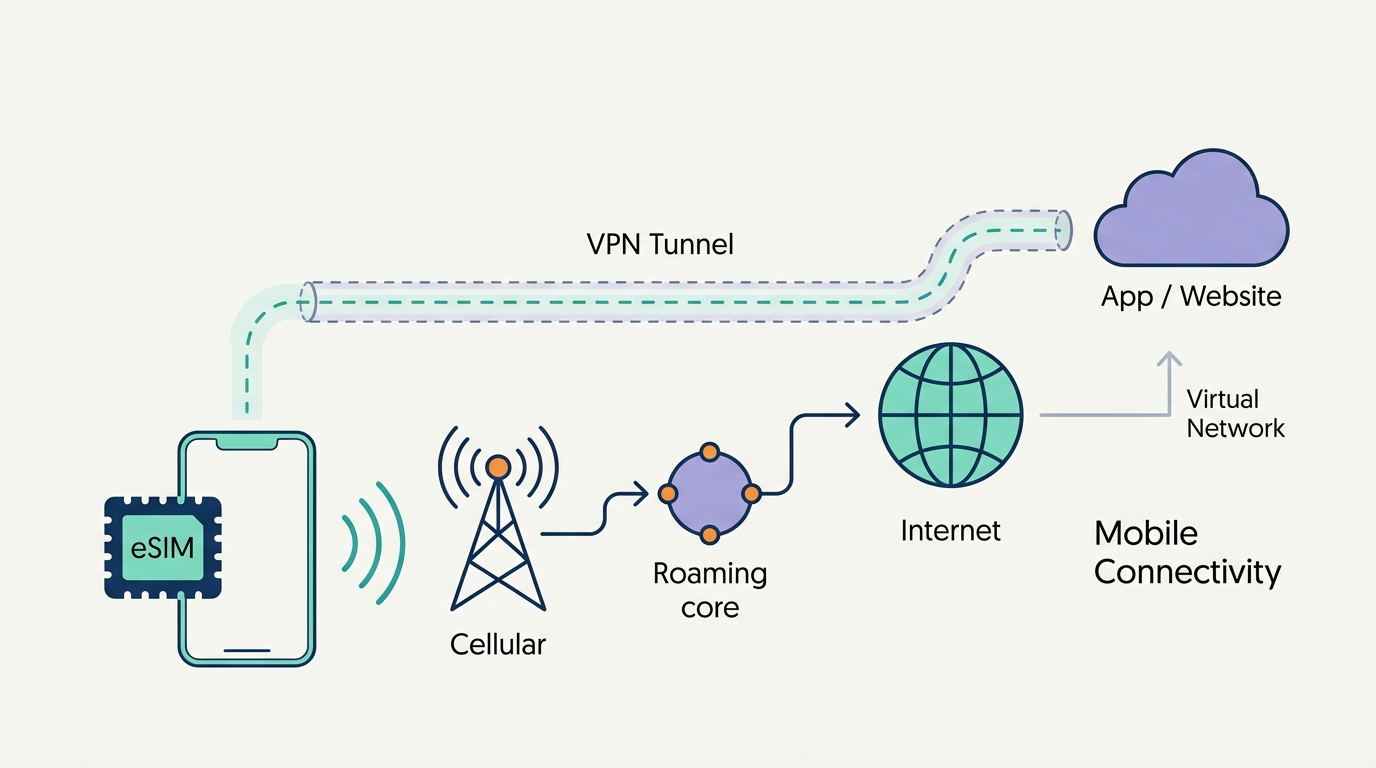
eSIM vs VPN at a glance
| Feature | eSIM | VPN |
|---|---|---|
| Main purpose | Provision access to a mobile service | Build a virtual/protected network over an existing connection |
| Provides internet by itself | With an active mobile plan, yes | No; a VPN needs an existing connection |
| Uses SIM identity | Yes | No |
| Can operate over Wi-Fi | eSIM is not the Wi-Fi service | Yes |
| Can operate over eSIM mobile data | Not applicable | Yes |
| Changes the public exit IP seen by sites | Mobile service uses its own network exit IP | Often shows a VPN exit IP, depending on design |
| Guarantees a local IP | No | No |
| Guarantees anonymity | No | No |
| Changes GPS | No | Generally no |
| Changes SIM country/phone number | No | No |
| Useful on public Wi-Fi | A mobile eSIM can replace the Wi-Fi connection | A VPN can run over the Wi-Fi connection |
| Can affect speed/latency | The mobile network defines the base connection | Extra routing and processing can affect performance |
This is a conceptual comparison. VPN protocols, encryption, routing, exit locations, and privacy policies vary by service.
What is an eSIM?
The GSMA defines eSIM around remote SIM provisioning: a SIM profile can be securely downloaded into an embedded secure element in a device.
For a traveler, the practical distinction is:
Physical SIM:
insert a removable card

eSIM:
download the carrier's SIM profile
The fundamental role of the SIM still involves:
- Mobile-network identity.
- Carrier subscription.
- Network registration.
- Mobile data.
- Voice and SMS when included in the plan.
An eSIM is therefore primarily about:
mobile connectivity
not:
internet privacy tooling
For the fundamentals, read:
What Is an eSIM? A Complete Guide to Travel eSIMs
What is a VPN?
VPN stands for Virtual Private Network.
NIST describes a VPN as a virtual network built on top of existing physical networks that can provide a secure communications mechanism between networks or nodes.
In other words, a VPN usually does not provide the first internet connection.
You still need to get online through something such as:
- eSIM mobile data.
- A physical SIM.
- Home Wi-Fi.
- Hotel Wi-Fi.
- A corporate network.
- Ethernet.
Then the VPN operates on top of that connection.
A simplified path looks like:
Phone
  ↓
eSIM / Wi-Fi / Ethernet
  ↓
Internet
  ↓
VPN tunnel / virtual network
  ↓
VPN server or corporate network
  ↓
Website / service
That is why eSIM and VPN are not competing products at the same layer.
Can an eSIM replace a VPN?
No.
A travel eSIM solves a question such as:
How do I get mobile internet in Japan, Korea, or Europe?
It does not automatically solve:
Do I need a secure tunnel into my company?
Which network exit IP will a website see?
Do I need a separate routing or security layer?
Likewise, a VPN alone cannot solve:
I just landed and there is no Wi-Fi. How does my phone get internet?
A VPN needs an underlying network first.
The common combination: eSIM + VPN
They can work together.
For example:
Caylet Travel eSIM
→ local mobile network
→ VPN
→ corporate network / internet
or:
Travel eSIM
→ VPN
→ SaaS / email / web
The roles are:
- eSIM provides the mobile-data connection.
- VPN applies additional routing or security on top.
Google's current Pixel VPN documentation also notes that the VPN cannot work without an available internet connection.
Do you need a VPN when using an eSIM?
Not necessarily.
It depends on why you want a VPN.
Normal travel browsing
If you mainly use:
- Maps.
- WhatsApp.
- YouTube.
- Websites.
- Ride-hailing.
- Email.
modern services commonly use HTTPS/TLS and other application-level encryption.
That does not remove every security risk, but using a travel eSIM does not automatically create a requirement to buy a VPN.
Your employer requires one
If company policy requires:
connect to the corporate VPN before internal systems
you still need that VPN when using a travel eSIM.
You use public Wi-Fi
An employer may require its VPN on hotel, airport, or café Wi-Fi.
For personal use, the decision depends on your security, privacy, and networking requirements.
You need a particular VPN exit
That is a VPN-routing feature, not an eSIM feature.
Use of any VPN should comply with local law, service terms, and account rules.
Does an eSIM encrypt internet traffic?
This needs careful wording.
Mobile networks have their own access-security mechanisms, and an eSIM profile participates in mobile-network authentication.
But that is not equivalent to:
eSIM = end-to-end VPN encryption
Whether application traffic is protected end to end also depends on:
- HTTPS/TLS.
- Application protocols.
- The service itself.
- Whether an additional VPN is used.
- Corporate security architecture.
Do not market “mobile-network security” as if every eSIM encrypts all internet activity like a VPN tunnel.
Does a VPN encrypt all traffic?
Not necessarily.
VPN deployments can use:
Full tunnel
Most or all configured traffic goes through the VPN.
Split tunnel
Only selected traffic uses the VPN while other traffic goes directly through the normal connection.
Per-app VPN
Only specific applications use the VPN.
Apple's managed VPN architecture and other modern platforms support different routing models.
So:
VPN ON
does not necessarily mean:
100% of every packet from every app goes through one VPN server
The actual behavior depends on the configuration.
Does a VPN change your IP address?
Many consumer VPN services cause websites to see the VPN server's public exit IP instead of the direct mobile-network exit IP.
But the word VPN does not guarantee that you can:
- Pick any country.
- Get a residential IP.
- Get a mobile IP.
- Avoid VPN detection.
- Access every geographically restricted service.
For example, Google's built-in VPN on supported Pixel devices explicitly states that it cannot be used to change the IP location to access content unavailable in the user's region.
Keep these ideas separate:
VPN tunneling/security
and:
consumer VPN location selection
Does an eSIM change your IP address?
It gives you a network path with a different exit IP, but for a different reason.
When you move from:
home Wi-Fi
to:
travel eSIM mobile data
websites will normally see a different public network address because you are now using a different provider and route.
That does not mean the eSIM is simulating a VPN.
Travel-eSIM traffic may be routed through:
- A local partner carrier.
- A roaming core.
- A regional internet gateway.
- An upstream provider.
As a result, you can physically be in Japan while an IP geolocation database reports Hong Kong, Singapore, or another location.
The next guide will cover this in detail:
👉 Related Reading: Why Does My eSIM Show an IP Address in Another Country?
Does an eSIM guarantee a “mobile IP”?
No.
A travel eSIM uses a mobile telecommunications network, but that does not guarantee the public address seen by every website will be:
- Classified as mobile by every IP database.
- Dedicated to you.
- Residential.
- Locally originated.
- Different after every reconnect.
Mobile networks can use:
- Carrier-Grade NAT.
- IPv4.
- IPv6.
- Shared gateways.
- International core networks.
- Different upstream autonomous systems.
Do not convert:
Uses a mobile network
into a product claim such as:
Guaranteed mobile residential IP
unless the provider makes a specific, verifiable commitment.
Does a VPN always use a data-center IP?
Not by definition.
A VPN can terminate through:
- Data-center servers.
- Cloud infrastructure.
- Private networks.
- Residential exits.
- Mobile exits.
- Enterprise gateways.
So:
VPN = data-center IP
is not universally true.
👉 Related Reading: Mobile IP vs Data-Center VPN IP: What Is the Difference?
Can an eSIM hide your real location?
Do not make that claim.
“Location” can refer to several different signals:
- GPS.
- Cell-tower location.
- Wi-Fi positioning.
- IP geolocation.
- SIM/carrier country.
- Device region.
- Account history.
An eSIM primarily changes the mobile service and network path you use.
It does not automatically change:
- GPS.
- iPhone/Android region settings.
- Time zone.
- Apple or Google account country.
- App location permissions.
- Historical account data.
Avoid marketing language such as:
eSIM hides your real location
Can a VPN hide your real location?
A more accurate statement is that a VPN can change the network location inferred from the public IP.
It generally does not automatically change:
- GPS.
- Bluetooth beacon location.
- Device time zone.
- Location Services.
- SIM country.
- Login history.
- Cookies.
- Account profile data.
A VPN is therefore not:
one-click total location spoofing
Can an eSIM or VPN make a financial account “safer”?
Do not guarantee this.
Banks, payment platforms, and other high-value services may evaluate combinations of:
- Account history.
- Device.
- IP.
- Geographic signals.
- Phone/SIM information.
- Cookies.
- App integrity.
- Behavior.
- Transaction risk.
- Other internal signals.
Caylet Blog should not claim:
Use this eSIM to avoid bank risk controls
Use VPN country X to pass verification
Use a mobile IP to prevent account suspension
Neither an eSIM nor a VPN guarantees that an account:
- Will avoid risk controls.
- Will avoid additional verification.
- Will remain unrestricted.
- Will be treated as located in a particular country.
Users should follow service terms and provide accurate, lawful account information.
Which is better for public Wi-Fi?
If you already have a travel eSIM, one simple option is:
skip the public Wi-Fi
→ use your own mobile data
That reduces dependence on a network you do not control.
If you must use public Wi-Fi, a VPN can operate on top of that Wi-Fi and provide a virtual/protected network path, depending on its configuration.
The roles are different:
eSIM:
provides another internet-access path

VPN:
protects/routes traffic over an internet-access path
For a broader comparison, read:
eSIM vs Pocket Wi-Fi vs Public Wi-Fi: Which Is Best for Travel?
Can a VPN slow down an eSIM connection?
It can, but not always.
A VPN can add:
- Encryption/decryption work.
- A VPN-server hop.
- Additional routing distance.
- Encapsulation overhead.
Possible effects include:
- Higher latency.
- Lower download throughput.
- Lower upload throughput.
- Additional battery use.
Sometimes a VPN route can perform better to a specific destination than the original route, so do not promise a universal slowdown.
Avoid claims such as:
VPN always reduces speed by X%
The effect depends on:
- VPN protocol.
- Server distance.
- Server load.
- Mobile network.
- Device CPU.
- MTU.
- Destination.
- Full versus split tunnel.
Does a VPN use more eSIM data?
VPN protocols add some encapsulation overhead, so the same application payload can result in slightly more transmitted data.
Do not publish one fixed percentage for every VPN.
The largest sources of data use are still often:
- Video.
- Cloud sync.
- Video meetings.
- Hotspot use.
- Operating-system updates.
Monitor the actual plan balance when using a small data allowance.
Does a phone VPN also cover hotspot devices?
It depends.
With:
Travel eSIM
→ VPN
→ Personal Hotspot
the behavior depends on:
- iOS or Android.
- VPN application.
- VPN protocol.
- Whether tethered traffic is included.
- Split-tunnel policy.
- Enterprise management settings.
Do not promise:
Every device connected to the hotspot automatically uses the phone's VPN
and do not promise the opposite.
If this matters for work, test the exact phone and VPN configuration before departure.
Corporate VPN vs consumer VPN
Both can use VPN technology, but the goals may differ.
Corporate VPN
Common uses include:
- Accessing internal systems.
- Connecting to private company networks.
- Applying security policy.
- Remote work.
Consumer VPN
Common uses may include:
- Additional protection on untrusted networks.
- Using a different public exit.
- Personal privacy preferences.
Do not define every VPN as a “country changer.”
NIST's core VPN definition is about virtual networking and secure communications, not geographic content switching.
Are VPN, proxy, and Private DNS the same?
No.
VPN
Can create a virtual network/tunnel and route some or all configured IP traffic.
Proxy
Usually intermediates specific protocols, applications, or traffic.
Private DNS
Primarily changes or protects DNS resolution. It does not automatically tunnel all internet traffic through a VPN server.
Do not use these terms interchangeably in the blog or product UI.
Can websites still identify you when you use an eSIM?
Yes.
An eSIM does not make a user anonymous.
Websites and apps can still use signals such as:
- Signed-in accounts.
- Cookies.
- Device information.
- App data.
- IP address.
- GPS permission.
- Browser storage.
- Payment information.
- Behavior.
A VPN does not automatically erase these signals either.
Avoid claims such as:
eSIM = anonymous browsing
VPN = complete anonymity
Should you travel with eSIM + VPN?
Use the scenario that matches your needs.
You only need reliable mobile data
Travel eSIM
may be enough.
Your employer requires a corporate VPN
Travel eSIM
+
Corporate VPN
You must use public Wi-Fi and your employer requires a secure tunnel
Public Wi-Fi
+
Corporate VPN
You want to avoid public Wi-Fi
Travel eSIM
can provide your own mobile connection.
You need a specific consumer-VPN feature
Travel eSIM
+
Trusted VPN service
while still checking local law, service terms, and the VPN provider's privacy policy.
Quick decision table
| Requirement | eSIM | VPN |
|---|---|---|
| Get mobile connectivity after landing | Excellent fit | Cannot do this alone |
| Get online where there is no Wi-Fi | Yes | Needs eSIM/SIM or another connection first |
| Access a corporate private network | Supplies the base internet | Often the required tool |
| Avoid relying on public Wi-Fi | Use cellular instead | Does not create first-mile internet |
| Build a virtual/protected tunnel | Not the core purpose | Core purpose |
| Show a VPN exit IP to websites | Not its purpose | Depends on VPN service |
| Change GPS | No | Generally no |
| Change SIM country | No | No |
| Guarantee anonymity | No | No |
| Multi-country mobile data | Regional/global eSIM can | VPN itself does not provide a data plan |
Pre-travel checklist
eSIM
- Destination is covered.
- Device supports eSIM.
- Device is carrier-unlocked.
- Data and validity are sufficient.
- Data roaming requirements are known.
- Any IP-location requirement is understood.
- Hotspot support is known.
VPN
- Why do I need the VPN?
- Is it corporate or personal?
- Is the provider trustworthy?
- Which VPN protocol is used?
- Is it full tunnel or split tunnel?
- Does it include hotspot traffic?
- Does it interfere with company apps?
- Does use comply with local law and service terms?
- What happens if the VPN disconnects?
- Have I tested it before travel?
Frequently asked questions
Can an eSIM replace a VPN?
No. An eSIM provides mobile-network connectivity; a VPN operates on top of an existing connection.
Do I need a VPN when using an eSIM?
Not necessarily. Normal travel browsing may not require one, while corporate policy or specific security/routing needs may.
Can a VPN run over eSIM mobile data?
Yes. If the eSIM provides working internet access, a VPN can run over that connection.
Does an eSIM hide my IP address?
It gives you the mobile network's public exit path, but it should not be described as an IP-hiding tool. Websites still see a public network address.
Why can a travel eSIM show an IP in another country?
Mobile-core routing, roaming architecture, or an upstream internet gateway may be located in another market. That does not prove the eSIM is using a VPN.
Does a VPN always change the IP country?
No. It depends on the VPN service and exit. Some VPN products explicitly do not provide geographic location switching.
Does a VPN change GPS?
Generally no. IP geolocation and GPS are separate signals.
Is an eSIM more secure than a VPN?
That is not a useful direct comparison. An eSIM provides mobile identity/connectivity; a VPN provides virtual networking or tunnel security.
Does a VPN always slow mobile data?
No, but extra encryption, routing, and a server hop can increase latency or reduce throughput.
Does a VPN use more eSIM data?
There is protocol overhead, but the amount varies. Do not assume a universal percentage.
Can an eSIM or VPN bypass bank risk controls?
There is no guarantee. Financial and other high-value platforms can use many signals. Follow service terms and accurate account-information requirements.
Official references
- GSMA: eSIM technology and use cases
- GSMA: What is eSIM for Consumer and IoT?
- NIST: Virtual Private Network (VPN) definition
- NIST SP 800-77: Guide to IPsec VPNs
- Apple: Virtual private network (VPN) security
- Google Android: Connect to a virtual private network (VPN)
VPN protocol, exit location, privacy policy, performance, split tunneling, and data handling should be taken from the specific VPN service or corporate IT policy. eSIM coverage, mobile routing, data allowance, and product capabilities should come from the Caylet product and order data.
Summary
The simplest distinction is:
eSIM = gets you onto a mobile network
VPN = creates a virtual/protected connection over a network you already have
Therefore:
- An eSIM cannot replace a VPN.
- A VPN cannot replace an eSIM.
- They can work together.
- An eSIM does not guarantee a local IP.
- A VPN does not guarantee anonymity.
- A VPN generally does not change GPS, SIM identity, or account history.
- Mobile IP geolocation and VPN exit IP are separate concepts.
For most travelers, solve the first problem first: reliable connectivity. Add a VPN when corporate policy, privacy, public-Wi-Fi, or specific routing requirements justify it.


