

Quick answer: “Business eSIM” is usually not a different piece of eSIM hardware or a separate GSMA technical standard. It is a product or service positioning built around business travel, cross-border work, remote work, laptop tethering, multi-country coverage, and connectivity resilience. For an individual professional, the important question is not whether the plan has “Business” in its name. It is whether the plan actually provides the capabilities your work needs: reliable destination coverage, sufficient data, hotspot/tethering, clear activation and validity rules, multi-country options, a practical backup strategy, and support when something fails. Larger organizations may additionally require central purchasing, billing, usage controls, APIs, administration, policy, or contractual SLAs. A service should not imply those enterprise capabilities merely because it uses the word “Business.”
“Business eSIM” sounds as though it should be a different kind of SIM.
Technically, that is usually not the right way to think about it.
The GSMA maintains eSIM architectures for consumer Remote SIM Provisioning and separately for IoT use cases involving network- or user-interface-constrained devices. An employee, founder, creator, consultant, or remote worker using an iPhone or Android phone for travel is normally still using consumer eSIM technology.
Therefore labels such as:
Travel eSIM
Business eSIM
Holiday eSIM
Remote Work eSIM
often describe:
product positioning / use case / service capabilities
rather than four incompatible eSIM technologies.
The key definition
Business eSIM ≠ a new eSIM technical standard
A more useful model is:
Business eSIM
=
eSIM mobile connectivity
+
features suitable for work
+
optional business management/support capabilities
The actual product determines what is included.
How is a Business eSIM different from a normal travel eSIM?
It may not be technically different at all.
A normal travel eSIM that has:
- Coverage where you work.
- Enough data.
- Hotspot support.
- Suitable validity.
- Reliable partner networks.
- Acceptable latency.
- Clear activation rules.
can be perfectly usable for business.
Do not create an artificial rule:
Travel eSIM = leisure only
Business eSIM = work only
The meaningful distinction is:
Is the product suitable for the work requirement?
not the label.
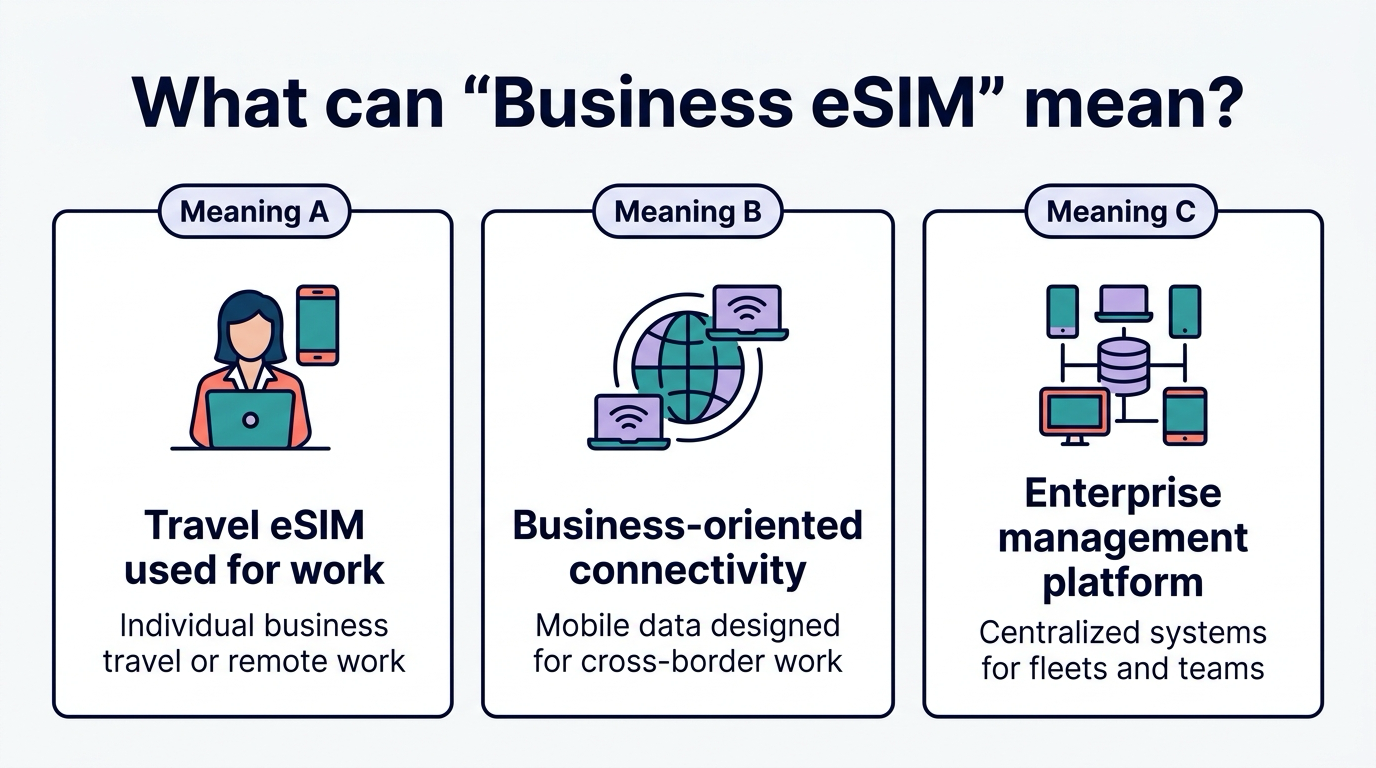
Three different things people call “Business eSIM”
Type 1: A normal travel eSIM used for work
This is extremely common.
A:
- Freelancer.
- Cross-border ecommerce operator.
- Content creator.
- Consultant.
- Founder.
- Digital nomad.
- Traveling employee.
may buy a normal consumer travel eSIM and use it mainly for:
Email
Slack
Teams
Zoom
Remote Desktop
Cloud apps
Laptop hotspot
Business travel
That remains:
a consumer eSIM product used for business
There is no need to pretend that the underlying technology changed.
Type 2: A business-oriented travel connectivity service
A provider may position a plan as “Business” because it emphasizes:
- Multi-country coverage.
- Larger data options.
- Hotspot.
- Longer validity.
- Easy repeat purchases.
- Backup connectivity.
- Clear network information.
- Business-oriented support.
- Receipts or invoices.
- Purchasing for several travelers.
Only features that actually exist should be advertised.
Type 3: True enterprise mobile-connectivity management
A larger company may require:
- Central procurement.
- Multiple users.
- Multiple devices.
- Admin dashboard.
- Permissions.
- Department-level spending.
- Usage policies.
- API access.
- Automated provisioning.
- Fleet management.
- Enterprise support.
- Contractual SLA.
That is far beyond simply selling one travel eSIM.
If Caylet does not currently provide these capabilities, do not describe it as:
Enterprise Mobility Platform
or:
Enterprise eSIM Management
Is a Business eSIM the same thing as an IoT eSIM?
No.
The GSMA also maintains an IoT eSIM Remote SIM Provisioning architecture for devices that can be network constrained or user-interface constrained.
That can apply to certain:
- Sensors.
- Industrial devices.
- Remote IoT endpoints.
- Connected equipment.
A cross-border worker using:
iPhone
Android phone
tablet
is normally in a consumer eSIM use case.
Therefore:
Business eSIM for travelers
does not mean:
GSMA IoT eSIM architecture
Do not use IoT specifications as marketing proof for ordinary smartphone travel plans.
Who benefits most from a Business eSIM?
Frequent international business travelers
If a traveler regularly moves through:
- Japan.
- Korea.
- Singapore.
- Malaysia.
- United States.
- Europe.
finding and replacing a physical SIM in every destination adds operational friction.
Regional or global eSIM plans can reduce:
buying
collecting
swapping
storing
SIM cards.
Digital nomads and remote workers
Their main questions are usually not:
Can I scroll social media?
They care about:
- Can Zoom remain usable?
- Can the laptop tether to the phone?
- Can Remote Desktop work?
- Can the corporate VPN connect?
- Is there enough high-speed data?
- Do I need a new profile at every border?
Cross-border founders and small-business operators
They may need to handle:
- Email.
- ERP.
- CRM.
- SaaS.
- Customer support.
- Ecommerce dashboards.
- Cloud documents.
- Advertising tools.
- Website administration.
The core requirement is:
reliable internet access
not a magical “business-only IP.”
Content creators
Work may involve:
- Uploads.
- Cloud backup.
- Hotspot.
- High data use.
- Frequent country changes.
That can make data planning much more important than it is for casual sightseeing.
Travelers who need backup connectivity
If hotel Wi-Fi failure could interrupt work, a travel/business eSIM can provide:
another mobile access path
But real redundancy depends on failure domains, not simply buying a second brand.
Read:
Why Business Travelers Need a Backup Mobile Internet Connection
What capabilities matter most in a Business eSIM?
There is no single feature list that every worker needs.
Evaluate at least these nine areas.
1. Destination coverage
Start with:
Where will I work?
If a trip crosses many countries, managing a separate local eSIM for each border can add friction.
Compare:
- Local eSIM.
- Regional eSIM.
- Global eSIM.
Guide:
Local vs Regional vs Global eSIM: Which One Should You Choose?
2. Partner networks
Coverage should not be reduced to:
Country = supported
Look at:
Supported Networks
when reliable product data exists.
Plans with multiple partner carriers may provide:
- Better coverage in some areas.
- An alternative partner when one radio network has a local issue.
But:
multiple carriers
does not equal complete redundancy.
They may still share:
- Supplier.
- Profile.
- Mobile core.
- Device.
3. Data and high-speed allowance
Work can consume substantially more data than casual travel.
High-usage activities include:
- Zoom.
- Teams.
- Cloud backup.
- Large downloads.
- Video uploads.
- Laptop tethering.
Do not evaluate only the word:
Unlimited
Also check:
- High-speed allowance.
- Daily limit.
- Fair-use policy.
- Throttling.
- Reset policy.
- Top-up.
Unlimited does not necessarily mean unlimited full speed.
4. Hotspot and tethering
This is particularly important for cross-border work.
With:
Travel eSIM
→ Phone
→ Personal Hotspot
→ MacBook
the phone can temporarily replace a Pocket Wi-Fi device.
But hotspot support is plan-specific.
Do not assume every eSIM permits tethering.
Guide:
Can a Travel eSIM Use Hotspot, Calls, and SMS?
5. Activation and validity
Backup connectivity makes one question especially important:
When does the validity clock start?
If you want to keep a backup eSIM ready but the plan starts validity immediately after installation, it may not be suitable for long warm standby.
Business-oriented product pages should clearly expose:
- Installation timing.
- Activation event.
- Validity start.
- Expiration.
- Top-up.
Do not make the traveler guess.
6. Speed and latency
Business does not mean:
guaranteed fastest network
Mobile performance still depends on:
- 4G/5G.
- Signal.
- Congestion.
- Partner carrier.
- Roaming core.
- Internet breakout.
- Throttling.
- Destination server.
Without a contractual SLA, do not promise fixed Mbps or latency.
7. VPN compatibility
Many organizations use:
Internet
→ Corporate VPN
→ Company systems
The travel eSIM provides the first internet segment.
Normal IP connectivity can carry VPN traffic, but real-world behavior can still depend on:
- VPN protocol.
- Corporate firewall.
- MTU.
- Tethering.
- Application policy.
A Business eSIM should not claim:
Compatible with every corporate VPN
unless formally tested.
For the networking model:
eSIM vs VPN: What Is the Difference, and Can an eSIM Replace a VPN?
8. Backup capability
A business user may need:
Primary
+
Backup
but redundancy depends on whether the paths share a failure domain.
For example:
eSIM A → Carrier X
eSIM B → Carrier X
has limited carrier independence.
Likewise:
Phone travel eSIM
→ Hotspot
→ Laptop
still has one upstream connection.
A resilient business setup may consider:
- Another carrier.
- Another access technology.
- Another device.
- Power backup.
9. Support and manageability
An individual travel eSIM can sometimes be as simple as:
QR
Install
Use
Business users may care more about:
- Order history.
- Receipt/invoice.
- Usage visibility.
- Fast support.
- Multiple purchases.
- Employee assignment.
- Admin dashboard.
- API.
But none of these should be inferred from the word “Business.”
If Caylet currently only supports:
individual order management
show only the capabilities that exist.
Does a Business eSIM always include an admin dashboard?
No.
There is no rule that a “Business eSIM” must include:
Team Dashboard
Some products are simply:
travel eSIMs optimized or positioned for business use
True enterprise services may add:
- Team management.
- Central billing.
- Role permissions.
- APIs.
- Fleet management.
Evaluate the actual service.
Does a Business eSIM always provide an invoice?
No.
If reimbursement matters, verify:
- Receipt.
- Invoice.
- Legal entity.
- Tax information.
- Currency.
- Billing fields.
If Caylet only issues a payment receipt, do not label it:
VAT Invoice
Tax Invoice
unless it legally qualifies.
Does Business eSIM mean static IP?
No.
A normal travel/business eSIM may use mobile-network addressing that is:
- Shared.
- Behind CGNAT.
- Dynamic.
- IPv4.
- IPv6.
- Routed through another internet breakout.
- Associated with different ASNs.
Therefore:
Business
does not mean:
Static IP
Dedicated IP
Local IP
Residential IP
Those are separate capabilities.
Does Business eSIM guarantee a mobile-classified IP?
Its access layer uses a mobile network.
But the final public exit classification seen by an IP database depends on:
- Mobile core.
- Roaming.
- Internet breakout.
- ASN.
- Public IP pool.
- Database classification.
Do not translate:
uses mobile network
into:
Guaranteed Mobile IP
For the distinction:
Mobile IP vs Data-Center VPN IP: What Is the Difference?
Why can a Business eSIM show an IP in another country?
Because:
Coverage Country
and:
Internet Breakout Country
are not the same attribute.
You can be:
physically in Japan
connected to a Japanese carrier
while an IP lookup says Singapore
and the mobile service may still be functioning normally.
Common explanations include:
- Home-routed roaming.
- Regional gateways.
- Mobile core architecture.
- IP-geolocation databases.
Read:
Why Does My eSIM Show an IP Address in Another Country?
Can a Business eSIM make financial accounts “safer”?
Do not make that promise.
Banks, payment services, SaaS platforms, and other high-value systems can evaluate combinations of:
- Account history.
- Device.
- IP.
- ASN.
- Cookies.
- Phone/SIM information.
- Location.
- Transactions.
- Behavior.
- Internal risk systems.
A Business eSIM therefore cannot reasonably guarantee:
Bank-friendly
Safe for PayPal
Safe for Stripe
Safe for U.S. banks
Avoid risk controls
Avoid verification
What it can provide is:
mobile connectivity
not the outcome of another company's account-security system.
When a service requires accurate identity, residence, business, or location information, follow that service's rules.
Can a Business eSIM replace a corporate VPN?
No.
They solve different problems:
Business eSIM:
internet connectivity

Corporate VPN:
private/corporate network path
A common architecture is:
Laptop
  ↓
Phone Hotspot
  ↓
Business / Travel eSIM
  ↓
Internet
  ↓
Corporate VPN
  ↓
Company Systems
The eSIM can be the underlying internet access for a corporate VPN, but it does not replace the VPN.
Can Business eSIM replace hotel Wi-Fi?
It does not need to.
A more useful division is:
Mobile data:
mobility + backup + connectivity outside the hotel

Hotel / office Wi-Fi:
large transfers + indoor secondary path
They complement each other.
Can Business eSIM replace Pocket Wi-Fi?
It depends.
eSIM is often better when
- One person is traveling.
- You want less hardware.
- The phone supports eSIM.
- Countries change frequently.
- Laptop usage is moderate.
- Phone hotspot is sufficient.
Pocket Wi-Fi may fit when
- Several Wi-Fi-only devices are used.
- Multiple people need long sharing sessions.
- A separate device is desirable.
- Device redundancy matters.
There is no universal winner.
How should a Business eSIM work with the home line?
A common configuration is:
Home SIM:
Calls + SMS + OTP

Business/Travel eSIM:
Mobile Data
This keeps the normal number available while travel data uses the new line.
Home-carrier roaming charges remain carrier-specific.
Do not promise:
receiving SMS abroad is always free
A practical setup for a cross-border worker
Normal mobile connection
Business / Travel eSIM
for:
- Email.
- Slack.
- WhatsApp.
- Maps.
- Work apps.
- Laptop hotspot.
High-volume connection
Trusted Hotel / Office Wi-Fi
for:
- Cloud backup.
- Large downloads.
- OS updates.
- Longer meetings.
Emergency backup
Home roaming
or
a second independent mobile plan
Corporate networking
Corporate VPN
when required by the employer.
Power
Charger
+
Power bank
because two eSIMs do not help when the phone has no power.
Should you choose local, regional, or global Business eSIM?
Local
Good for:
- One country.
- Longer stay.
- Simple destination requirement.
Regional
Good for:
- Southeast Asia.
- Europe.
- Multi-country business trips.
- Reducing profile changes at borders.
Global
Good for:
- Highly distributed itineraries.
- Many short stops.
- Minimizing repeated purchasing.
A global plan is not automatically:
- Faster.
- Cheaper.
- Local-IP enabled.
- Higher priority.
- Better on every carrier.
Compare the actual product.
Should a Business eSIM be unlimited?
Not necessarily.
If work is mostly:
- Email.
- Messaging.
- Maps.
- Small documents.
a fixed-data plan can be more economical.
If work includes significant:
- Video meetings.
- Hotspot.
- Uploads.
- Cloud sync.
an unlimited-style product may be attractive.
Still check:
- High-speed allowance.
- Daily reset.
- Fair-use policy.
- Reduced speed.
- Hotspot limit.
Do not buy based only on the word “Unlimited.”
How early should you prepare a Business eSIM?
The correct timing depends on:
installation policy
activation policy
validity start
When:
early installation is supported
+
installation does not start validity
preparing in advance can reduce arrival-day risk.
If:
installation starts the validity clock
do not activate too early.
Product and order instructions take priority over generic blog advice.
How should you compare Business eSIM cost?
Do not compare only:
price per GB
Business use also involves:
- Number of countries.
- Validity.
- Hotspot.
- Top-up.
- Repeated local-plan purchases.
- Roaming alternative.
- Pocket Wi-Fi cost.
- Cost of connectivity failure.
- Backup requirement.
A slightly more expensive regional plan can sometimes reduce operational friction compared with several cheaper local plans.
That is not universally true, so compare the actual itinerary.
Which features are truly enterprise-grade?
Only when a service actually provides capabilities such as:
Team accounts
Central billing
Role-based access
Employee assignment
Usage policy
Fleet management
API
Central provisioning
SLA
Service credits
Dedicated account support
should stronger enterprise positioning be considered.
Without them, avoid claims such as:
Enterprise-grade
Enterprise Mobility Platform
Enterprise eSIM Management
as factual product descriptions.
Does a Business eSIM include an SLA?
Not unless the product or contract says so.
Business
is not synonymous with:
SLA
A provider can say:
designed for business travel
without claiming:
99.99% uptime
guaranteed service
priority network
zero downtime
Does Business eSIM mean priority network access?
Do not assume it.
Mobile networks can have different:
- QoS.
- Roaming priority.
- APNs.
- Subscription classes.
But unless the supplier explicitly provides:
priority data
priority network access
the word “Business” alone is not evidence of a higher carrier priority.
Is Business eSIM suitable for teams?
Potentially, but evaluate the actual service.
Small teams may only need
- Individual purchases.
- Reimbursement.
- Shared product links.
- Consistent coverage recommendations.
Larger organizations may need
- Admin dashboard.
- Bulk purchasing.
- Assignment.
- Usage reporting.
- Central billing.
- Support workflows.
If Caylet has no current:
team management
do not imply that it does.
How to choose a Business eSIM
Use a practical sequence.
Step 1: List the itinerary
Countries
Dates
Trip duration
Step 2: List critical work
For example:
Email
Video meetings
Remote Desktop
Hotspot
File upload
Corporate VPN
Step 3: Estimate data
Separate:
phone-only usage
from
laptop tethering
Laptop work can use substantially more data.
Step 4: Confirm hotspot
If a MacBook must connect:
hotspot support
should be explicit.
Step 5: Confirm activation
Especially for a backup eSIM.
Step 6: Check partner networks
Where reliable data exists, compare:
- Network.
- 4G/5G.
- Supported carriers.
Step 7: Prepare a backup
Do not let critical work depend on:
one network
one phone
one battery
Business eSIM purchase checklist
- Covers every destination.
- Device supports eSIM.
- Device is carrier-unlocked.
- Data allowance is sufficient.
- High-speed allowance is understood.
- Fair-use policy is understood.
- Hotspot capability is confirmed.
- Validity is confirmed.
- Activation event is confirmed.
- Partner networks are understood.
- Corporate VPN requirement has been tested.
- Home-line calls/SMS strategy is clear.
- Backup path is prepared.
- Power bank is prepared.
- Receipt/invoice requirement is confirmed.
- No dependency on unpromised Local IP, Static IP, or SLA capabilities.
Quick decision table
| Requirement | What to check |
|---|---|
| One-country business trip | Local coverage + data + hotspot |
| Multi-country business trip | Regional/global coverage |
| Laptop work | Hotspot + data allowance |
| Frequent Zoom/Teams | High-speed data + network quality |
| Corporate VPN | Internet connectivity + pre-trip VPN test |
| Home-number SMS | Dual SIM + home line |
| Cannot tolerate an outage | Independent backup path |
| Large uploads | Data allowance + trusted Wi-Fi |
| Team use | Actual team/admin capabilities |
| Company reimbursement | Actual receipt/invoice support |
| Fixed/local IP | Must be explicitly supported; never infer |
| SLA requirement | Requires a real contractual SLA |
Frequently asked questions
Is a Business eSIM technically different from a travel eSIM?
Not necessarily. Many Business eSIMs use the same consumer eSIM technology; the difference is product capability and use-case positioning.
Is Business eSIM a separate GSMA standard?
For ordinary smartphone business-travel use, that is not a useful interpretation. GSMA maintains Consumer eSIM and IoT eSIM technical architectures; “Business eSIM” is usually a commercial/use-case description.
Can a normal travel eSIM be used for work?
Yes, if its coverage, data, hotspot, validity, and network capabilities meet the job requirements.
Does every Business eSIM support hotspot?
No. Check the specific plan.
Does every Business eSIM include a phone number?
No. Many plans remain data-only.
Does Business eSIM guarantee a local IP?
No. Coverage and internet breakout are separate properties.
Does Business eSIM guarantee a mobile-classified IP?
It uses mobile access, but public IP classification depends on routing, ASN, and the IP-intelligence database.
Can Business eSIM replace a VPN?
No. The eSIM supplies internet connectivity; a VPN operates on top of that connection.
Is Business eSIM safer for banks, payment platforms, or company accounts?
It can provide ordinary mobile connectivity, but it cannot guarantee any third-party platform's security review, verification, or risk-control outcome.
Does every Business eSIM have an SLA?
No. An SLA exists only when the product or contract explicitly provides one.
Should a company use normal eSIMs or an enterprise management platform?
A few travelers may be well served by normal travel/business eSIMs. Organizations needing central management, APIs, policy, team billing, or contractual SLAs should choose a service that actually provides those enterprise capabilities.
Why does business travel still need a backup?
A larger data allowance does not eliminate carrier, device, power, or upstream network failures. Backup design reduces single-point-of-failure risk.
Official and technical references
- GSMA: eSIM Consumer and IoT Specifications
- GSMA: SGP.21 v2.7 Consumer eSIM Architecture
- GSMA: SGP.31 v1.3 eSIM IoT Architecture and Requirements
- Apple: Use Dual SIM on iPhone
- Apple: Use eSIM while traveling internationally with your iPhone
- NIST SP 800-34 Rev. 1: Contingency Planning Guide for Federal Information Systems
GSMA specifications describe eSIM technical architectures. When Caylet or another provider uses the term “Business eSIM,” actual product capabilities should come from the product page, order data, supplier network information, and any formal contract.
Summary
The useful way to understand “Business eSIM” is not as a new technical standard, but as a way to evaluate mobile connectivity for work.
Remember:
- Business eSIM is not necessarily a separate eSIM standard.
- A normal travel eSIM can also be used for work.
- The word Business does not automatically mean hotspot, local IP, static IP, priority network, or SLA.
- Cross-border workers should prioritize coverage, data, hotspot, activation, partner networks, and backup.
- An eSIM provides connectivity and cannot replace a corporate VPN.
- Mobile IP, local IP, and financial-account safety are separate questions.
- True enterprise management requires real team, billing, API, policy, or SLA capabilities.
- For critical work, connectivity redundancy matters more than simply buying a larger plan.
For an individual cross-border worker, a useful Business eSIM setup can be simple:
A Caylet eSIM that fits the itinerary
+
Laptop hotspot
+
Trusted Wi-Fi
+
A genuinely usable backup path
+
Power backup
There is no need to invent a “magic business network.”
The real value is:
keeping work connected
while you move across borders


